SEO vs Social Media: Which Is Better for Your Business? | C2D
SEO and social media can both help businesses grow online. Learn the differences, benefits, limitations, and when to use each strategy for your business with C2D.
SEO vs Social Media: Which Is Better for Your Business?
When a business wants to grow online, two common strategies often come up: Search Engine Optimization (SEO) and social media marketing.
Both can help businesses reach potential customers, build brand awareness, and generate opportunities. However, they work in very different ways.
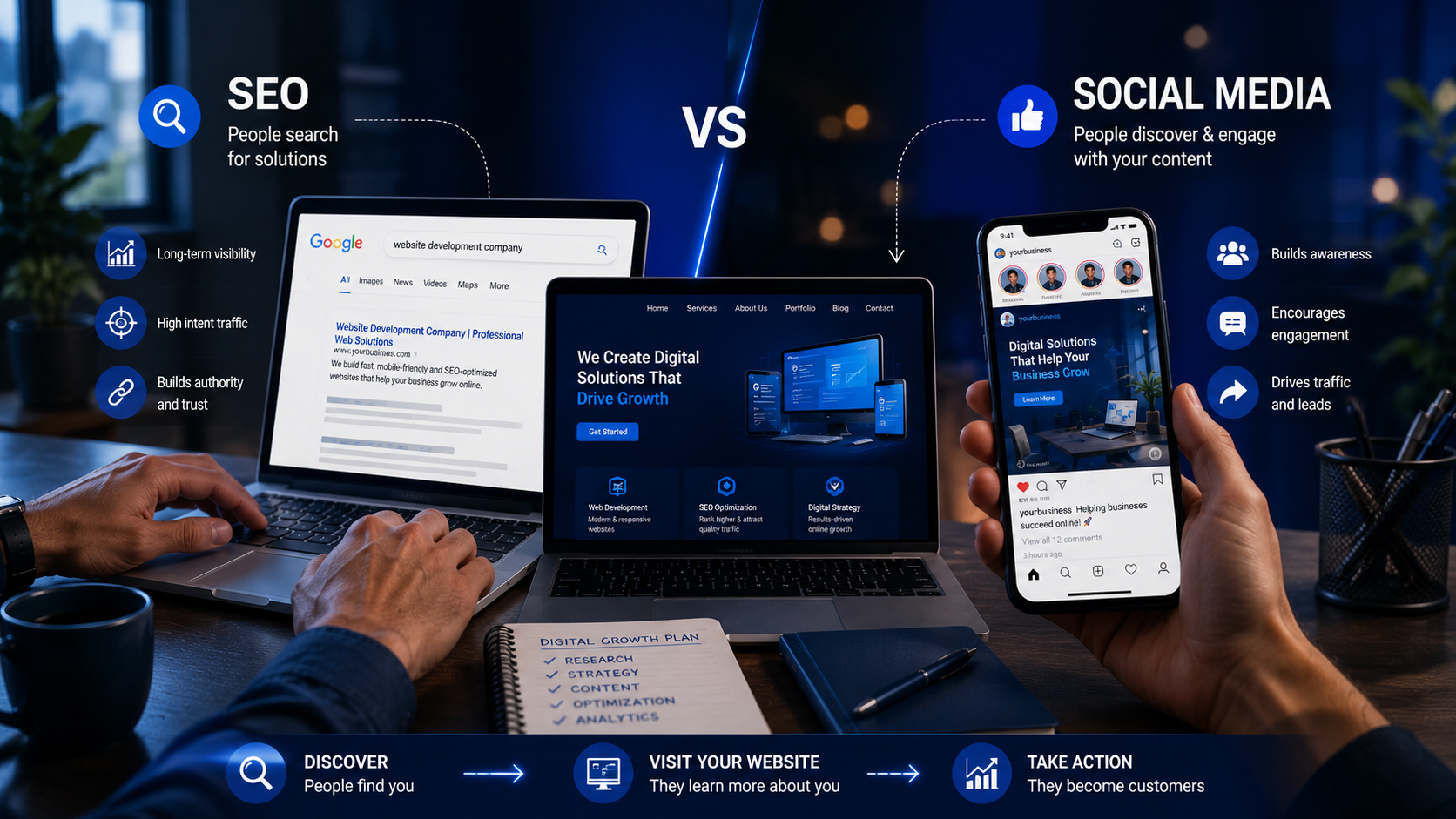
SEO helps people discover your business when they search for information, products, or services on search engines. Social media helps businesses connect with audiences through platforms where people discover, interact with, and share content.
So which one is better?
The answer depends on your business goals, audience, industry, budget, and the type of customers you want to reach.
At C2D (Concept to Deploy), we believe businesses should choose digital marketing channels based on their goals rather than simply following the latest trend.
In this guide, we'll compare SEO and social media marketing, explain how each works, and help you decide where your business should focus.
What Is SEO?
Search Engine Optimization (SEO) is the process of improving a website and its content so that search engines can better understand the information and users can discover relevant pages through search.
For example, imagine someone searches for:
best website development company for small business
A business with useful, relevant, and well-optimized content may have an opportunity to appear in search results for related searches.
SEO can involve:
- Keyword research
- Useful content
- Page titles
- Headings
- Internal linking
- Technical SEO
- Mobile-friendly design
- Website performance
- Local SEO
- Image optimization
SEO focuses heavily on helping people discover your business through relevant search queries.
What Is Social Media Marketing?
Social media marketing involves using social media platforms to communicate with an audience, share content, build awareness, and create opportunities for engagement.
Depending on the business and audience, platforms may include:
- YouTube
- Other relevant social platforms
Social media content can include:
- Images
- Short videos
- Educational posts
- Product demonstrations
- Customer stories
- Business updates
- Behind-the-scenes content
- Offers and announcements
Unlike search, social media often introduces content to people while they are browsing a platform rather than actively searching for a specific service.
SEO vs Social Media: The Main Difference
The simplest way to understand the difference is through search intent.
With SEO, a person often starts with a question or search:
Search → Discover → Visit Website → Take Action
With social media, the journey may look like:
Discover Content → Engage → Visit Profile → Visit Website → Take Action
Both journeys can lead to customers, but they begin differently.
SEO and Social Media Comparison
| Factor | SEO | Social Media |
|---|---|---|
| Primary purpose | Search visibility | Audience engagement and awareness |
| Discovery | People actively search | People discover content while browsing |
| Main asset | Website and content | Social profiles and content |
| Content types | Articles, pages, guides, FAQs | Posts, images, videos, stories |
| Relationship building | Indirect | Highly interactive |
| Long-term value | Can build over time | Depends heavily on continued activity |
| Best for | Search-driven discovery | Awareness and engagement |
Benefits of SEO for Businesses
1. Helps People Find Your Business Through Search
SEO can help your website become more discoverable for searches related to your products, services, and expertise.
This can be especially valuable when potential customers are actively looking for a solution.
2. Builds Long-Term Website Visibility
Useful content can continue attracting visitors after it has been published.
This does not mean rankings are permanent or guaranteed. Search results can change as competition, search algorithms, websites, and user behaviour change.
However, consistently creating useful content can contribute to a stronger long-term search presence.
3. Supports Your Website
SEO sends potential customers toward your website, where you can provide detailed information about your business, services, products, and contact options.
4. Helps Target Search Intent
Search queries can provide valuable insight into what people are looking for.
For example, someone searching for website development cost has a different intent from someone searching for what is a website.
Understanding this intent can help businesses create more relevant content.
Benefits of Social Media Marketing
1. Builds Brand Awareness
Social media can help businesses introduce their brand to new audiences through regular content.
2. Encourages Direct Interaction
People can comment, share, message, and interact directly with businesses.
This can help businesses understand their audience and build relationships.
3. Supports Visual Content
Businesses that depend on visual presentation can benefit significantly from platforms that emphasize images and video.
For example, restaurants, photographers, makeup artists, fashion businesses, interior designers, and many creative businesses can use visual content to demonstrate their work.
4. Content Can Be Shared
Useful or interesting social content can be shared by users, potentially exposing the business to additional audiences.
Which Is Better for Getting Customers?
Neither SEO nor social media is automatically better for every business.
The right choice depends on how your customers discover and evaluate businesses.
SEO can be particularly useful when customers actively search for the products or services you provide.
Social media can be particularly useful when customers discover businesses through visual content, recommendations, trends, communities, or ongoing engagement.
For many businesses, using both can create a stronger overall strategy.
When Should Your Business Focus on SEO?
SEO may be a strong option if:
- Your customers regularly use search engines
- Your services solve specific problems
- People search for your products or services
- You want to build website traffic
- You can consistently create useful content
- You want to build long-term organic visibility
- You operate in a local market
For example, a local service business may benefit from creating useful service pages and location-focused content that helps potential customers discover it through search.
When Should Your Business Focus on Social Media?
Social media may be a strong option if:
- Your audience is active on social platforms
- Your business is highly visual
- You want to build brand awareness
- You can regularly create engaging content
- Your business benefits from community interaction
- You want to communicate directly with customers
- Your products are suitable for visual demonstrations
Can SEO and Social Media Work Together?
Absolutely.
In fact, combining SEO and social media can create a stronger digital marketing system.
For example:
SEO → Website → Useful Article → Social Media Content
One detailed blog article can become several social media posts, short videos, graphics, or educational pieces.
Social media can then help bring additional attention to that content.
At the same time, SEO can help people who are actively searching for related information discover the website.
How Your Website Connects SEO and Social Media
Your website should act as the central destination for many of your digital marketing activities.
For example:
Social Media → Website → Service Page → Enquiry
And:
Google Search → Blog → Service Page → Enquiry
This is why businesses should not treat their website as separate from digital marketing.
A professional website provides the place where visitors can learn more, evaluate your business, and take action.
If you are still planning your website, read How to Plan Your Business Website Before You Build It.
SEO vs Social Media for Small Businesses
Small businesses often have limited time and marketing budgets.
Instead of trying to do everything immediately, start by identifying where your potential customers are most likely to discover you.
Ask yourself:
- Do customers search Google for my service?
- Do customers discover businesses through social media?
- Is my business highly visual?
- Do I need more website visitors?
- Do I need more brand awareness?
- Can I consistently create content?
The answers can help determine where to place your initial focus.
SEO vs Social Media: Which Is More Affordable?
Both strategies can be implemented with different levels of investment.
Businesses can start creating useful website content without paying for every visitor. However, SEO requires time, effort, quality content, and ongoing optimization.
Social media platforms may allow businesses to create organic content without paying for every post. However, consistent content creation also requires time and resources.
Paid advertising can be added to either strategy, but advertising costs vary depending on the platform, audience, competition, and campaign goals.
The most important question is not simply which channel is cheaper. It is which channel can help your business achieve its goals efficiently.
Common Mistakes Businesses Make
Businesses sometimes make the mistake of choosing a marketing channel simply because it is popular.
Common mistakes include:
- Trying to use every social media platform
- Ignoring search intent
- Creating content without a clear audience
- Expecting immediate SEO results
- Posting on social media without a strategy
- Ignoring the business website
- Measuring only likes and followers
- Not tracking enquiries or conversions
A good strategy starts with the customer and business goal, not the platform.
How to Choose Between SEO and Social Media
Use this simple decision process.
Choose SEO First If:
- People actively search for your services
- You want to increase organic website traffic
- You can create useful website content
- Your business benefits from search visibility
Choose Social Media First If:
- Your audience spends significant time on social platforms
- Your business is highly visual
- You need to build brand awareness
- You can create engaging content consistently
Use Both If:
- You want both search visibility and brand awareness
- Your website can support your marketing efforts
- You have the resources to create useful content
- Your customers discover businesses through multiple channels
How C2D Approaches Digital Marketing
At C2D (Concept to Deploy), we believe a strong digital presence should connect different parts of a business rather than treating every channel as an isolated activity.
Your website, SEO, content, social media, and digital marketing strategy should support the same business goals.
For example, a business could:
- Build a professional website
- Create useful SEO-focused content
- Share that content on social media
- Guide visitors toward relevant service pages
- Make it easy for visitors to contact the business
- Measure meaningful results
This creates a connected digital journey instead of disconnected marketing activities.
Final Thoughts
So, SEO vs social media: which is better for your business?
There is no single answer.
SEO can help businesses reach people who are actively searching for information, products, or services. Social media can help businesses build awareness, communicate with audiences, and create ongoing engagement.
For many businesses, the strongest strategy is not choosing one and ignoring the other.
Instead, use SEO to build search visibility, use social media to build awareness and relationships, and use your website as the central destination where visitors can learn more and take action.
Start with the channel that best matches your audience and goals, then expand your digital marketing strategy as your business grows.
Continue Your Digital Marketing Journey With C2D
Now you understand the difference between SEO and social media marketing.
The next step is learning how to create content that actually attracts and helps your target audience.
What's Next?
In the next guide, we'll explore content marketing, why it matters for businesses, and how to create useful content that can support SEO, social media, and customer growth.
Next: Content Marketing Strategy for Small Businesses
Build Your Digital Presence With C2D
At C2D (Concept to Deploy), we help businesses turn their ideas into practical digital solutions through professional websites, SEO-focused content, and digital growth strategies.
Concept → Build → Optimize → Deploy → Grow.