How to Do Keyword Research for Your Small Business | C2D
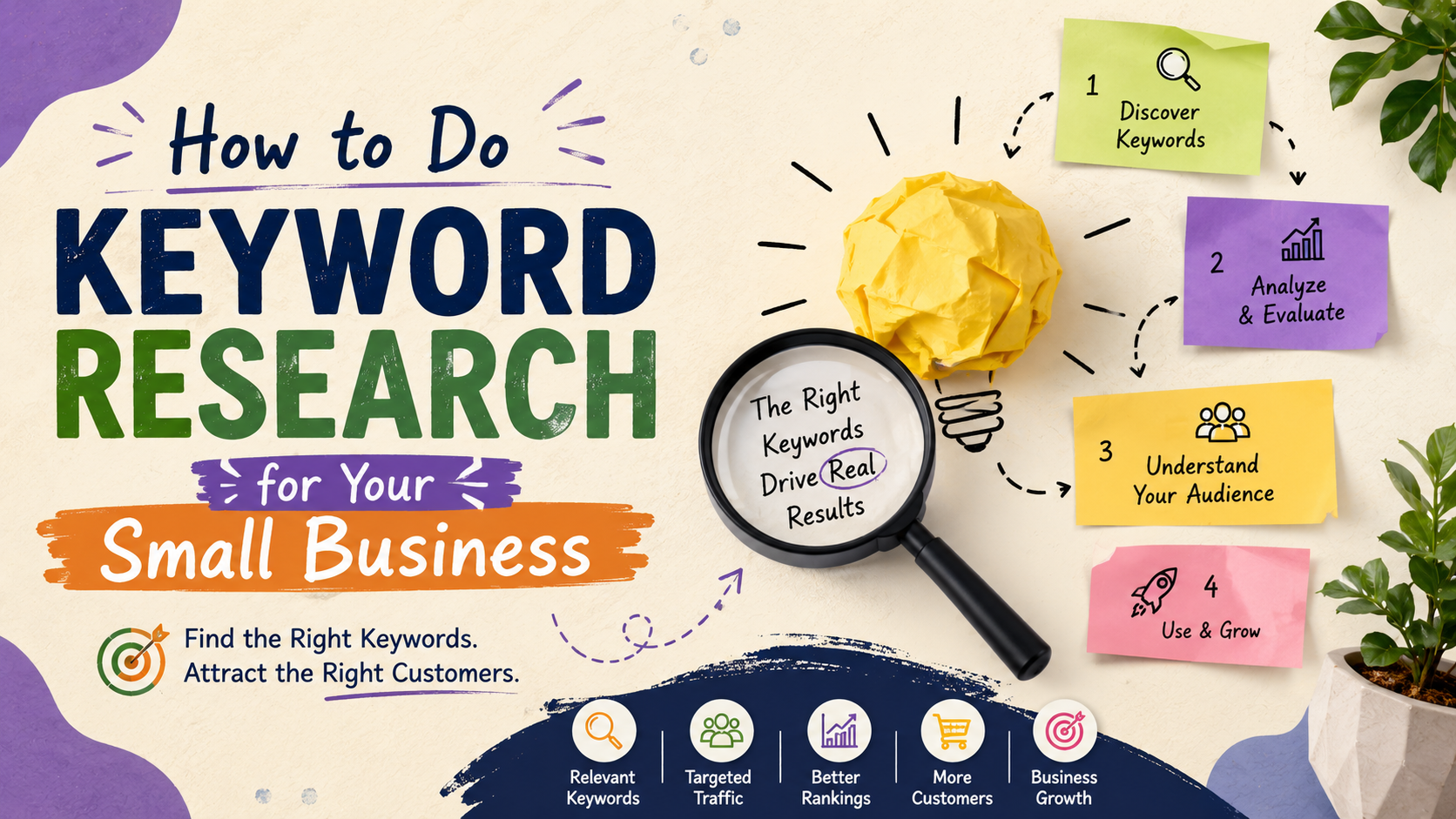
Learn how to do keyword research for your small business, understand search intent, find relevant keywords, and use them naturally to improve your SEO strategy with C2D.
How to Do Keyword Research for Your Small Business
When people need a product, service, or answer, they often begin with a search engine.
They type words or phrases into Google to find information, compare options, solve problems, or decide what to buy.
For businesses, understanding those searches can provide valuable insight into what potential customers are looking for.
This is where keyword research becomes an important part of search engine optimization.
Keyword research helps businesses identify relevant words and phrases that people use when searching for information related to their products, services, and industry.
At C2D (Concept to Deploy), we believe keyword research should be based on understanding customers and their search intent rather than simply collecting a large list of popular keywords.
In this guide, we'll explain what keyword research is, why it matters, how to find useful keywords, how to understand search intent, and how small businesses can use keywords naturally in their SEO strategy.
What Is Keyword Research?
Keyword research is the process of discovering and analyzing the words and phrases people use when searching online.
For example, a person looking for a website development service might search for:
- website development company
- business website development
- website development company in Trichy
- professional website for small business
- website development cost
These searches can help a business understand what information potential customers are looking for.
Keyword research is therefore not just about finding words to place inside an article. It is about understanding the questions, needs, and problems behind those searches.
Why Is Keyword Research Important?
Keyword research can help businesses create content that is more closely aligned with what their audience is searching for.
A good keyword strategy can help you:
- Understand your audience
- Discover content opportunities
- Identify customer questions
- Plan website pages
- Improve content relevance
- Support SEO
- Understand search intent
- Find potential topics for blogs
However, keyword research does not guarantee rankings.
Search visibility depends on many factors, including content quality, relevance, competition, website quality, technical factors, and the overall search experience.
What Is a Search Query?
A search query is the word or phrase a person enters into a search engine.
For example:
best website for small business
is a search query.
The person may be trying to learn what makes a good business website and may not yet be ready to hire a developer.
Another person may search:
website development company near me
This may indicate stronger commercial intent because the person could be looking for a service provider.
Understanding this difference is an important part of keyword research.
What Is Search Intent?
Search intent is the reason behind a person's search.
Two people can search for similar topics but have completely different goals.
Common types of search intent include:
- Informational intent
- Navigational intent
- Commercial investigation
- Transactional intent
Informational Intent
The person wants to learn something.
Examples:
- What is SEO?
- How does digital marketing work?
- What is a business website?
Navigational Intent
The person wants to find a particular website, business, or page.
Examples may include searches for a specific company or brand.
Commercial Investigation
The person is researching options before making a decision.
Examples:
- Best website development company
- Website development companies for small business
- Best SEO services for small business
Transactional Intent
The person is closer to taking an action such as buying, booking, requesting, or contacting.
Examples:
- Hire website developer
- Book website consultation
- Buy website hosting
Understanding search intent helps you create the right type of content for each keyword.
Short-Tail vs Long-Tail Keywords
Keywords can also be broadly categorized based on their length and specificity.
Short-Tail Keywords
These are usually broad phrases containing relatively few words.
Examples:
- SEO
- web design
- digital marketing
These terms can have broad meanings and may be highly competitive.
Long-Tail Keywords
Long-tail keywords are usually more specific phrases.
Examples:
- SEO tips for small business websites
- how to create a website for a small business
- website development company for small businesses
These searches may have lower search volume than broad terms, but they can be more specific to a particular need.
How to Find Keyword Ideas
There are several ways a small business can discover keyword ideas.
1. Start With Your Products and Services
Make a list of the products or services your business provides.
For a website development company, the list might include:
- Website development
- Business websites
- Website redesign
- Website maintenance
- SEO
- Mobile-friendly websites
These topics can become the starting point for keyword research.
2. Think Like Your Customer
Ask yourself what a potential customer would type into Google if they needed your service.
Do not only think about professional industry terminology.
Customers may use simple language or describe their problem rather than the technical name of a service.
3. Use Customer Questions
Your existing customers can provide excellent keyword and content ideas.
Write down questions customers frequently ask.
For example:
- How much does a website cost?
- How long does website development take?
- Do I need SEO for my website?
- How can I get more customers from Google?
- How can I make my website mobile-friendly?
Each question can potentially become a content topic.
4. Look at Related Searches
Search engines can show related queries and suggestions around a topic.
These suggestions can help you discover different ways people search for similar information.
5. Study Competitor Topics
Review the topics covered by businesses operating in your industry.
Look for gaps where your business can provide clearer, more detailed, or more useful information.
The goal should not be to copy competitors.
Instead, use competitor research to understand what topics are already being discussed and where you can provide additional value.
Keyword Relevance Matters More Than a Huge List
It can be tempting to collect hundreds or thousands of keywords.
But a large keyword list is not necessarily useful.
A small business should focus on keywords that are:
- Relevant to the business
- Relevant to the target audience
- Connected to customer needs
- Appropriate for the website
- Aligned with search intent
Ten highly relevant topics can be more useful than hundreds of unrelated keywords.
Understand Keyword Competition
Some keywords are highly competitive because many websites are targeting them.
For example, broad terms such as SEO or digital marketing can attract competition from large websites and established businesses.
A small business may also find opportunities in more specific topics.
For example:
SEO for local small businesses
is more specific than simply:
SEO
This does not mean every long-tail keyword is easy to rank for. Competition still varies by topic and location.
Search Volume Is Not Everything
Search volume estimates how frequently a keyword may be searched.
It can be useful when comparing topics, but it should not be the only factor you consider.
A keyword with high search volume may bring many visitors who are not interested in your service.
A more specific keyword may bring fewer visitors but attract people who are much closer to becoming customers.
For example:
website
is extremely broad.
While:
website development company for small business
is much more specific.
The second search may be more closely connected to a website development business's goals.
Create Keyword Groups
Instead of treating every keyword as a separate topic, group related keywords together.
For example, a business website topic could include:
- business website
- small business website
- professional business website
- website for small business
These related phrases can help you understand the broader topic.
You do not need to create a separate page for every slight variation of a keyword.
One comprehensive page may be able to address several closely related searches.
Map Keywords to the Right Pages
Keyword mapping means deciding which keywords and topics should be associated with specific pages on your website.
For example:
| Page | Primary Topic | Search Intent |
|---|---|---|
| Homepage | Business website development | Commercial |
| Service Page | Website development services | Transactional |
| Blog | How to plan a business website | Informational |
| Blog | Website development cost | Commercial investigation |
This helps prevent unrelated topics from being forced onto the same page.
Use Keywords Naturally in Your Content
Once you have selected a topic, use relevant keywords naturally.
Important locations may include:
- Page title
- Main heading
- Introduction
- Subheadings where appropriate
- Body content
- Image alternative text when relevant
- Internal link text
- Meta information
You do not need to place the exact keyword everywhere.
Use natural language and related terms when they make sense.
Avoid Keyword Stuffing
Keyword stuffing means excessively repeating keywords in an unnatural attempt to influence search rankings.
For example, a paragraph that repeatedly says:
website development company, website development company, best website development company, website development company...
would be difficult to read and provide a poor experience.
Instead, write naturally and focus on answering the reader's question.
Use Keywords to Understand Topics, Not Just Rankings
Keyword research can reveal what your audience cares about.
If many people search for a particular question, that can be a signal that the topic deserves useful content.
This makes keyword research valuable beyond SEO.
It can help with:
- Blog planning
- FAQ creation
- Service page planning
- Social media ideas
- Video topics
- Customer education
Keyword Research for Local Businesses
Local businesses should consider location when it is genuinely relevant to their audience.
For example:
- website development company in Trichy
- SEO services in Trichy
- digital marketing company in Trichy
However, location keywords should only be used where the business actually serves that location.
Do not create pages for locations simply to attract searches if you do not provide services there.
Keyword Research and SEO Content
Keyword research should be connected to your overall content strategy.
Once you have identified useful topics, create content that genuinely answers the search.
For example:
Keyword Research → Search Intent → Content → Internal Links → Service Page → Business Action
This creates a connection between SEO and the customer's journey.
If you want to learn how to turn keyword research into useful content, read How to Create SEO-Friendly Content That Ranks and Helps Readers.
How Keyword Research Connects With Content Marketing
Keyword research can provide ideas for your content calendar.
For example, one group of keywords might inspire:
- A beginner guide
- A detailed blog article
- An FAQ
- A comparison article
- A service page
This allows businesses to build a more organized content strategy instead of publishing random topics.
For more information, read Content Marketing Strategy for Small Businesses.
Common Keyword Research Mistakes
1. Choosing Keywords Only Because They Have High Search Volume
High search volume does not automatically mean high business value.
2. Ignoring Search Intent
A keyword may appear relevant but represent a completely different user goal.
3. Targeting Extremely Broad Keywords
Broad keywords can be difficult to compete for and may not attract the right audience.
4. Creating Separate Pages for Every Similar Keyword
Closely related searches can often be addressed by one strong, comprehensive page.
5. Stuffing Keywords Into Content
Keyword repetition should never make content unnatural or difficult to read.
6. Forgetting the Customer
SEO is ultimately connected to people. Always consider whether the content actually helps the person who performed the search.
Simple Keyword Research Process
A small business can follow this basic process:
- List your products and services.
- Identify your target audience.
- Write down common customer questions.
- Find relevant search phrases.
- Group related keywords.
- Understand search intent.
- Consider competition and relevance.
- Map topics to the right pages.
- Create genuinely useful content.
- Measure and improve performance.
Keyword Research Checklist
- Identify your main business topics
- Understand your target audience
- List customer questions
- Find relevant keyword ideas
- Understand search intent
- Look for specific long-tail opportunities
- Consider keyword relevance
- Review competition
- Group related keywords
- Map keywords to pages
- Use keywords naturally
- Avoid keyword stuffing
- Create useful content
- Track performance
- Update your strategy over time
How C2D Approaches Keyword Research
At C2D (Concept to Deploy), we believe keyword research should begin with the customer rather than a spreadsheet of keywords.
Our approach connects:
- Business goals
- Customer needs
- Search intent
- Relevant topics
- Useful content
- Website structure
- SEO strategy
This helps businesses create content that is not only optimized for search but also useful to the people they want to reach.
Final Thoughts
Keyword research is one of the foundations of an effective SEO and content strategy.
But successful keyword research is not about finding the biggest possible keyword or repeating the same phrase throughout a page.
It is about understanding what people search for, why they search for it, and how your business can provide the most useful answer.
Start with your customers, identify their questions, research relevant search terms, understand search intent, and create content that genuinely helps.
When keyword research, useful content, SEO, and a strong website work together, your business can build a more meaningful online presence.
Continue Your Digital Marketing Journey With C2D
You now know how to find and organize keywords for your small business.
The next step is understanding another important part of SEO: local SEO and how businesses can improve their visibility when customers search for services in their area.
What's Next?
In the next guide, we'll explain how local SEO works, what local businesses should optimize, and how to improve your chances of being discovered by customers in your service area.
Next: Local SEO Guide for Small Businesses: How to Get Found by Nearby Customers
Build Your Digital Presence With C2D
At C2D (Concept to Deploy), we help businesses turn concepts into practical digital solutions through professional websites, SEO-focused content, and digital growth strategies.
Concept → Build → Optimize → Deploy → Grow.